Why We Built Dibri
Dibri helps web studios and freelancers spot website problems before their clients do. Here’s why we built it and what it can already monitor.
Why we are building Dibri
Probably one of the most unpleasant ways to find out a website is down is getting a message from a client:
Our website is down. Has it been down long?
Especially when you built this website and continue to maintain it.
Dibri was born out of roughly this exact problem.
What Dibri is
Dibri is a small website monitoring service. First and foremost, we are building it for web studios, freelancers, and anyone who maintains client websites.
The idea is very simple: find out about the problem before the client does.
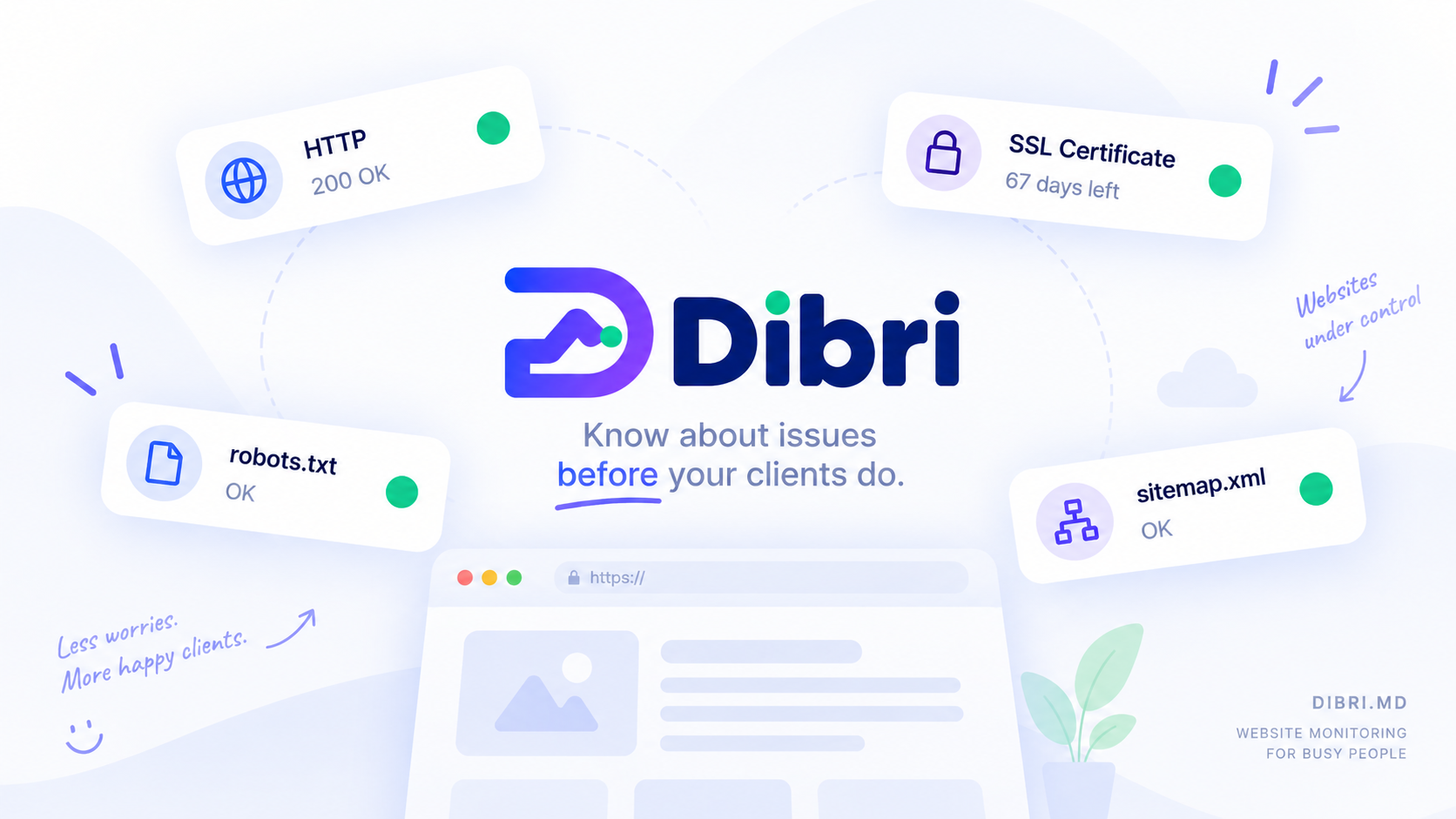
At the same time, simply checking if the server responds isn't always enough. The site might load but return the wrong HTTP code. The SSL certificate might be expiring. The robots.txt or sitemap.xml might disappear.
Each of these little things on its own doesn't look like a disaster. But when you are maintaining more than just one or two websites, checking all of this manually becomes unrealistic.
This is exactly what Dibri is meant to handle.
What is already working
Right now, Dibri can check:
website availability and HTTP status;
SSL certificate and how many days are left until it expires;
robots.txt;
sitemap.xml.
Checks run automatically, and the results are saved in the history.
If a problem occurs, Dibri records an incident and sends a notification. When everything is working again, the incident is closed.
You can currently receive notifications via email and Telegram.
So far, everything is quite simple. And this is on purpose.
We don't want to build a massive system right away with a hundred settings, half of which no one will ever need. It's better to gradually add checks and features that actually prove to be useful.
In the future, we'd like to get to more interesting things: checking not just the website's availability, but its actual performance. For example, page elements, forms, and entire user scenarios.
But that comes later.
Why this blog
Here, things are even simpler.
We will write about what is coming to Dibri: new checks, changes, fixes, and other notable things.
At the same time, in a while, it will be interesting to look back at how it all started.
And it all starts with a rather simple thought: it's better to find out that a client's website is down before the client does.